Understanding Our Audiences: The Design and Evolution of Science, Evolution, and Creationism
INTRODUCTION
For many years, the National Academy of Sciences (NAS)1 has been at the forefront in responding to challenges to the teaching of evolution, working with other national and state organizations with similar objectives (summarized in Alberts and Labov, 2004; Labov, 2005). The NAS has established a website2 that makes freely available its three current publications on evolution education (NAS, 1998, 1999, 2004; National Research Council, 1996). Other publications about evolution (e.g., Hazen, 2005; Ayala, 2007), a variety of position papers, and links to evolution resources from other organizations comprise the balance of the site.
One of these publications, Science and Creationism: A View from the National Academy of Sciences, 2nd ed. (NAS, 1999), has been widely used by people in many communities and especially by legal scholars and practitioners. It has been a prominent resource for major court cases, including Selman v. Cobb County Board of Education and Kitzmiller v. Dover Board of Education. The first edition (NAS, 1984) was originally prepared as an amicus brief for the United States Supreme Court.3 These booklets were important because they provided courts, educators, policy makers, and the public with a clear synopsis of the kinds of evidence that support both the fact and the theory of evolution, and they offered succinct explanations of the processes and nature of science (Ayala, 2008).
The second edition of Science and Creationism was released just before the ascent of the intelligent design creationism movement as a prominent voice in the “controversies” about evolution, and this publication devotes only two paragraphs to that challenge. Thus, the leaders of the NAS decided that an update to this booklet that addresses these more recent challenges was both timely and necessary. The new edition has been renamed Science, Evolution, and Creationism (SE&C) (Figure 1). Given the increasing importance of an understanding of evolution for prevention and treatment of disease, this new booklet has been developed jointly by the National Academy of Sciences and the Institute of Medicine (IOM).4 As with the two earlier editions, SE&C (NAS and IOM, 2008) was authored by a committee of prominent scientists, many of whom are members of the NAS or IOM. And, this committee includes two teacher leaders, both of whom have served as president of the National Association of Biology Teachers.
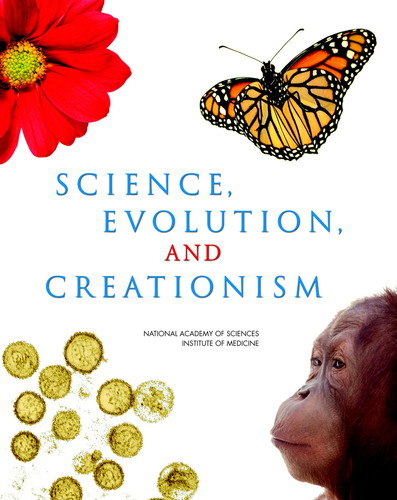
Figure 1. Cover of Science, Evolution, and Creationism.
However, unlike its predecessors, this new edition was shaped to a large extent by a careful program of audience research. This research was initiated to bring about a better understanding of the frame of reference that the intended audiences bring to this issue. The committee decided early in the revision process that its goal was to successfully inform opinion leaders and influentials who could then use this information to help reframe5 discussions about the evolution “controversy.” By presenting authoritative scientific information in ways that address the questions and concerns of those who are unsure about teaching evolution in science classrooms, the authoring committee would provide opinion leaders and influentials (scientists, business leaders, clergy, teachers, members of school boards, policy makers, judges, lawyers, and others) with the tools needed to change the understanding and decisions of other people who comprise the “wobbly middle.” They defined the wobbly middle as the large percentage of citizens that various national polls have shown to be undecided about whether or not evolution, creationism, or some combination should be taught in public school science classrooms.
LISTENING TO INTENDED AUDIENCES
The first phases of our research took place before a single word of the 2nd edition of Science and Creationism was changed. A second effort was undertaken after a near final product was prepared.
The first audience research project involved receiving information from four focus groups so that we could qualitatively understand the extent to which the public understood the issues involved in the evolution-intelligent design creationism “controversy.” These groups were also instrumental in determining the extent of peoples' understanding of the processes, nature, and limits of science. We tested the understanding of various messages about why nonscientific alternatives to evolution should not be taught in public school science classes.
Information garnered from these groups served as the basis for a quantitative telephone survey of 1000 people from across the United States to probe further some of these issues. This work was done in conjunction with the Coalition of Scientific Societies, a subset of a larger interdisciplinary coalition of >30 scientific, professional, and education societies and organizations. The list of all participating organizations in this coalition is found in Table 1. The data from this survey are summarized in a report from the Coalition of Scientific Societies (2007), and they are now being used by these organizations to inform their strategies and messages for confronting challenges to teaching evolution and related topics in other disciplines. This research also helped the committee to further refine the preparation of SE&C.
| Alliance for Human Research Protection | American Society for Investigative Pathology |
| Alliance for Science | American Society for Pharmacological and Experimental Therapeutics |
| American Anthropological Association | American Sociological Association |
| American Association for the Advancement of Science | Biophysical Society |
| American Association of Community Colleges | Biotechnology Institute |
| American Association of Physics Teachers | Coalition for Public Understanding of Science |
| American Astronomical Society | Consortium of Social Science Associations |
| American Chemical Society | EnvironCorp |
| American Civil Liberties Union | Estuarine Research Federation |
| American Crystallographic Association | Federation of American Societies for Experimental Biology |
| American Geological Institute | Geological Society of America |
| American Geophysical Union | National Academy of Sciences |
| American Institute of Biological Sciences | National Association of Biology Teachers |
| American Institute of Physics | National Science Teachers Association |
| American Physical Society | Research America |
| American Physiological Society | Sigma Xi |
| American Phytopathological Society | Society for Developmental Biology |
| American Psychological Association | Society for Neuroscience |
| American Society for Biochemistry and Molecular Biology | Society for the Study of Evolution |
| American Society for Human Genetics |
After the new edition of SE&C was drafted, we sent a composed and illustrated version of the booklet to representatives from the aforementioned groups of “influentials” and we engaged them in in-depth interviews about the booklet to provide even more direction. Several people who have been directly involved in addressing the evolution “controversy” at local, state, and national levels also provided additional feedback. All of those responses were used to further refine the draft that underwent final review by the members of the governing councils of the NAS and IOM.
HIGHLIGHTS FROM SCIENCE, EVOLUTION, AND CREATIONISM
SE&C begins by laying out the goals and premises of the booklet. Three main chapters, “Evolution and the Nature of Science,” “The Evidence for Biological Evolution,” and “Creationist Perspectives,” describe the booklet's main findings and premises. Following these chapters are nine “Frequently Asked Questions” about evolution, the nature of science, and what some people view as conflicts between science and religion (Table 2). The booklet also provides an extensive “Additional Reading” list and biographical sketches of committee members involved with the preparation of the booklet.
| Questions about science |
| Is evolution a theory or a fact? |
| Can random biological changes lead to more adapted organisms? |
| What evidence is there that the universe is billions of years old? |
| What's wrong with teaching critical thinking about “controversies” with regard to evolution? |
| Aren't there many questions that still surround evolution? |
| Questions about religion and science |
| Aren't evolution and religion opposing ideas? |
| Isn't belief in evolution also a matter of faith? |
| What are common ideas regarding creationism? |
| Wouldn't it be “fair” to teach creationism along with evolution? |
| Does science disprove religion? |
Based on what was learned from understanding our audiences, the organization and presentation of sections of the final product are different than what the authoring committee and project staff originally envisioned. For example, the committee began its work shortly after the decision of Judge John Jones III was announced in Kitzmiller et al. v. Dover Board of Education.6 The committee originally thought that this decision should be prominently touted throughout the booklet as one of the main reasons why various forms of creationism (including intelligent design) should not be taught in the science classroom—it's illegal. However, feedback from our research suggested that the public does not readily understand the role of the courts in such matters and believes that federal courts should not intervene in controversies in areas (such as school curriculum) that are viewed largely as locally controlled matters. Thus, although the booklet provides information about various court cases (Figure 2), these decisions are not featured as prominently as originally planned.
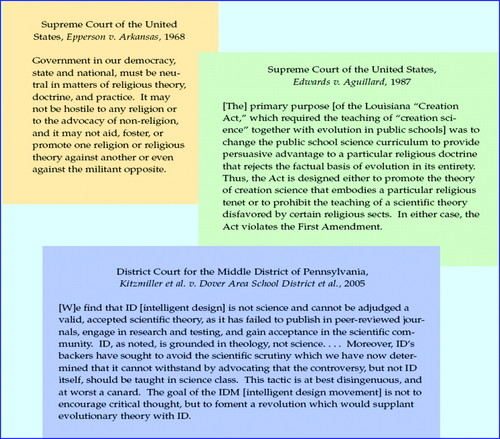
Figure 2. Descriptions in Science, Evolution, and Creationism of landmark federal court cases on the teaching of evolution and nonscientific alternatives.
The booklet highlights the contributions of multiple disciplines to the science of evolution, and it emphasizes emerging sciences such as genomics and evolutionary/developmental biology (evo/devo). It provides a clear and succinct definition of science and an extensive discussion about the nature, processes, and the limits of science (e.g., science as currently defined and practiced seeks natural explanations for phenomena and it is thus unable to investigate the supernatural). The science underlying evolution, including how we know what we know and evolution science's applications in medical, agricultural, industrial, and many other areas of scientific research and practice, are central themes of this updated version. A discussion called “Is Evolution a Fact or a Theory?” acknowledges the everyday definition of “theory” and then explains how scientists define and characterize facts and theories; it emphasizes that evolution is indeed both a well-documented fact and one of the most robust theories in all of science.
Compared with the previous two versions, there is more discussion in SE&C about how science and religion differ as ways of knowing and how, for many scientists and other people, acceptance of the evidence for evolution can be reconciled with personal faith. Published statements are provided from various religious denominations (Figure 3) and from prominent living scientists (Figure 4) declaring that acceptance of the evidence for evolution is compatible with the tenets of their faith.
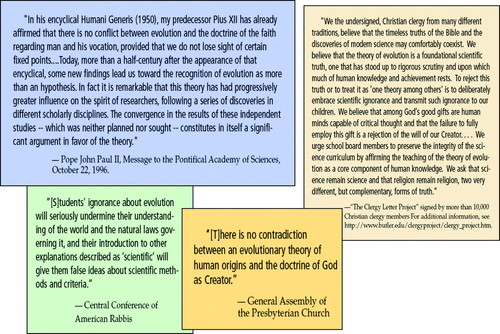
Figure 3. Published statements from several religious denominations on the compatibility of evolution and the tenets of their faith.
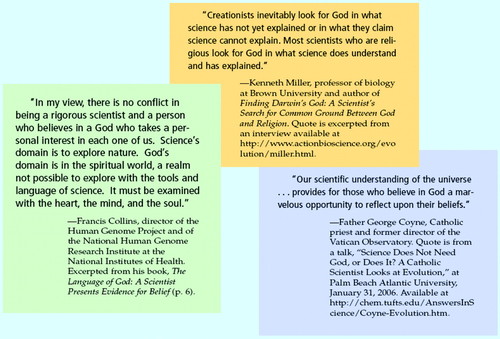
Figure 4. Published statements from scientists about the compatibility of evolution with their personal faiths.
SE&C is explicit about respecting the role of religion in individuals' lives, but not the introduction of religious and other nonscientific ideas into public school science classrooms. The booklet stresses the need to teach fundamental and long-accepted scientific concepts such as evolution to provide students with deeper understanding and appreciation of science and medicine. SE&C also makes clear why various forms of creationism, including intelligent design, are not scientific and should not be promulgated as acceptable “alternatives” to evolution in science courses under the guise of “fairness,” “academic freedom,” or “teaching the controversy.”
SE&C is available for reading, purchase, or as a free PDF download on the National Academies Press website.7 The NAS will work with the organizations in the coalition of scientific societies and especially with the organizations representing science teachers to distribute printed copies widely. For example, teachers who participated in the annual meeting of the National Association of Biology Teachers in Atlanta in November 2007 were able to submit requests to receive free copies after the booklet and 8-page brochure were released in January 2008.
Similarly, the first 500 readers of CBE—Life Sciences Education who submit code number SEC01 to http://nasonline.org/SECbookletrequest also will receive a free copy of the booklet.
If our nation is to continue to develop the talent necessary to advance scientific and medical research, we must ensure that high standards in science education are maintained and that efforts to introduce nonscience into science classes do not succeed. Failure to reach out effectively to a public that is supportive of science and open to information from the scientific community is not just a missed opportunity; it is a disservice to the scientific enterprise.
(Coalition of Professional Societies, 2007, p. 7)
SE&C was developed and organized by an expert committee of the NAS to help influentials better understand and thereby explain the principles of science in general, and evolution specifically, to other people with whom they interact. It makes clear that acceptance of the overwhelming and continually growing body of evidence for evolution need not be in conflict with religious beliefs for many people. Many students enter high school and college science courses harboring exactly these kinds of conflicts. The NAS and the IOM encourage science faculty to obtain a copy of this booklet and to use it as an authoritative resource to help communicate more effectively with the general public, and to address and assuage many of the concerns that our students bring with them to our classrooms and laboratories.
FOOTNOTES
1 The National Academy of Sciences is a private, nonprofit, self-perpetuating society to which distinguished scholars are elected for their achievements in research, and is dedicated to the furtherance of science and technology and to their use for the general welfare. Upon the authority of the charter granted to it by the Congress in 1863, the Academy has a mandate to advise the Federal Government on scientific and technical matters.
2 Available at http://nationalacademies.org/evolution.
3 Edwards v. Aguillar, which ruled that the teaching of “creation science” is unconstitutional (the finding from this case is summarized in Figure 2).
4 The Institute of Medicine was established in 1970 by the National Academy of Sciences as both an honorific and a policy research organization, to which members are elected on the basis of their professional achievement and commitment to service in the examination of policy matters pertaining to the health of the public.
5 The importance of framing issues without compromising scientific accuracy or integrity when scientists communicate with policy makers and the public has been articulated recently by Nisbet and Mooney (2007) and Nisbet and Scheufele (2007).
6 The judge's 139-page decision is available at http://www.pamd.uscourts.gov/kitzmiller/kitzmiller_342.pdf. The authors of this article recommend that all faculty who are trying to help students understand the processes, nature, and limits of science and why intelligent design is both religious and nonscientific should read this decision and share it with their students and professional colleagues.
7 Available at http://nap.edu/sec.