A Delicate Balance: Integrating Active Learning into a Large Lecture Course
Abstract
A lecture section of introductory biology that historically enrolled more than 500 students was split into two smaller sections of approximately 250 students each. A traditional lecture format was followed in the “traditional” section; lecture time in the “active” section was drastically reduced in favor of a variety of in-class student-centered activities. Students in both sections took unannounced quizzes and multiple-choice exams. Evaluation consisted of comparisons of student survey responses, scores on standardized teaching evaluation forms, section averages and attendance, and open-ended student comments on end-of-term surveys. Results demonstrate that students perform as well, if not better, in an active versus traditional environment. However, student concerns about instructor expectations indicate that a judicious balance of student-centered activities and presentation-style instruction may be the best approach.
INTRODUCTION
The recent furor over Mary Burgan's article “In Defense of Lecturing” points to the controversy that still surrounds the question of whether or not to lecture (Burgan, 2006; Rehm, 2007; Bland et al., 2007). Despite frequently being called passive and ineffective (Mazur, 1996; Powell, 2003), the lecture remains very much alive. It is relatively easy, after all, for instructors to lecture, and students have come to expect efficient content delivery (Hake, 1998; Walker and Jorn, 2007). Good lectures can be compelling, and the suggestion that lectures are inherently ineffective because students stop learning after 15 min has recently been called into question (Wilson and Korn, 2007). Add to this that instructors of large introductory classes may believe they have no viable option but to lecture, and the call to evaluate the effectiveness of lecturing, particularly compared with alternative engagement strategies, and particularly in large class environments, still seems a critical dimension of research.
Research in life sciences education has demonstrated the educational potential of active-learning techniques (McClanahan and McClanahan, 2002; Knight and Wood, 2005; Freeman et al., 2007), but much of this literature focuses on small classes, considers only small-scale implementations of active learning, or takes biology majors as subjects rather than the general student population. In this paper we describe the implementation and evaluation of a large-enrollment, introductory-level class that adopted a variety of active-learning techniques. By replacing most lecturing with student-centered activities (e.g., hands-on exercises, group work, practice quizzes), we tried to bring the effects of not lecturing into sharp focus. We showcase a mixed bag of results regarding the impact of active-learning techniques, including improvements in student learning outcomes along with less positive student evaluations of the course and its instructors. We conclude by recommending a mixed-format approach that blends structured active-learning exercises with mini-lectures to maximize the strengths of each approach to teaching.
MATERIALS AND METHODS
Background and Course Design
Biology 1001 (Evolutionary and Ecological Perspectives) holds the dubious distinction of being among the largest courses offered at our very large public institution. Each semester, approximately 1000 students enroll in 3 to 4 lecture sections and over 60 laboratory sections. Biology 1001 appeals to a diverse audience because of its core content—evolution, genetics, and ecology—and because it meets two general education requirements. At the time of this study, Biology 1001 was a mixed-majors course, with 90% of the students coming from outside of the College of Biological Sciences. These nonmajors included technology and premedicine students, as well as those from nonscience disciplines.
The challenges we encounter in Biology 1001 are documented in the literature on large-lecture environments (Wulff et al, 1987; Carbone, 1999; Cuseo, 2007) and on the shortcomings of the lecture method more generally (Penner, 1984; Milton, et al., 1986; Slavin, 1991; Bligh, 2000; Stanley and Porter, 2002; Cuseo, 2007). They include:
low attendance (<50%)
low and uneven student emotional engagement in class
lack of student preparedness
poor reputation
lack of immediate feedback on student understanding
lack of student metacognition
few opportunities for students to construct their own understandings of course material
little chance for active student engagement with course material
impoverished student learning outcomes, when compared with the use of more active techniques
In the fall of 2006, we decided to address these challenges. We believed that because science itself is dynamic, multidisciplinary, and problem-based, science courses are ideal candidates for student-centered approaches (Hake, 1998; Herreid, 1998; Zoller, 2000; Handelsman et al., 2004; DeHahn, 2005; Smith et al., 2005; Armstrong et al., 2007).
To make room in the class sessions for active-learning exercises, we made a conscious decision not to “cover” all of the class material during the designated class meetings. Previous research has shown that content-intensive courses can be less effective than minimized-content classes at promoting overall student understanding, particularly with nonscience majors (Sundberg et al., 1994; Crouch and Mazur, 2001; Knight and Wood, 2005). We felt that certain concepts and areas of knowledge received sufficient treatment in the class materials, especially in the textbook, so we decided not to discuss these areas during class even though students were held responsible on quizzes and exams for mastering them.
A lecture section of Biology 1001 that historically enrolled more than 500 students was split into two smaller sections of approximately 250 students each. The first section had course elements including lecture, unannounced quizzes, and multiple-choice exams; this will be referred to as the “traditional” section. The second section had course elements that included a wide variety of structured, ungraded, group activities, extremely shortened lectures, unannounced quizzes, a few graded homework assignments, and multiple-choice exams nearly identical to those of the first section. This was our “active” section. Both sections were team-taught by the same two experienced instructors and both included identical 20-person lab sections supervised by a graduate teaching assistant (differences between the sections are summarized in Table 1). Aside from two graded homework assignments, taking the place of two unannounced quizzes in the active section, grades were based on the same exercises in both courses. Both sections were offered in 75-min blocks on Tuesdays and Thursdays for 15 wk; the active section met from 11:15 to 12:30, whereas the traditional section met from 8:15 to 9:30.
| Course description | Traditional lecture | Active |
|---|---|---|
| Course elements | Lecture, quizzes, exams | Group work, mini lectures, quizzes, homework, exams |
| Time | 8:15 to 9:30 TTh | 11:15 to 12:30 TTh |
| Size | 240 | 263 |
| Quiz content | Lecture material | Based on reading, in-class activities, mini lectures, homework |
| Exam content | Lecture, text, outlines | In-class activities (10%), mini-lectures, text, outlines |
In-Class Activities
The students in the “active” section were randomly assigned to groups on the first day of class. We used a random-number generator (the “Magic 8 Ball”) to select groups that reported their findings to the entire class. When visuals were necessary to explain a concept, groups used a document camera to project their work. The instructors occasionally used mini-lectures that lasted 15 min or less to clarify concepts and highlight terminology from the textbook.
In their groups, students engaged in four different types of activities (activities are listed in Supplemental Material 1):
Process of science activities were exercises designed to help students generate testable hypotheses and explain observable phenomena, design experiments, and analyze authentic data from current scientific literature. For example, in one process of science activity (“helpers at the nest: pied kingfishers”), groups were charged with developing hypotheses to explain helping behavior in pied kingfishers. After large-group discussion of these ideas (facilitated by the Magic 8 Ball), groups analyzed authentic data on reproductive success in helpers and drew conclusions about the inclusive fitness benefits of altruism.
Groups used manipulatives in a type of desktop laboratory to kinetically explore fundamental principles. For example, we used a bag of beans to demonstrate allelic frequency change, pipe cleaners and paper clips for visualizing nuclear division, and Velcro-backed labels for narrating the events of DNA replication.
Immediate Feedback Assessment Technique (IF-AT) forms (Supplemental Material 2) are simple scratch-off answer sheets that can be used by individuals or groups as a formal testing tool or simply for self-evaluation. IF-ATs were used routinely during the semester as a way for groups of students to identify their misconceptions and receive feedback on their understanding (Epstein et al., 2002; Cotner et al., 2008).
Question massage activities involved student groups dissecting multiple-choice questions, “massaging” (rewording) the distractors, and exposing the logic behind misconceptions.
Hypotheses
We used the two sections of Biology 1001 to study the effects of active learning in a quasi-experimental design. We hypothesized that the incorporation of group activities into the class would have positive effects on student:
learning outcomes
confidence with respect to the course material
interest in science
perceptions of the usefulness of class activities
evaluations of course and instructors
attendance
Sample
The active section contained 263 students and the traditional section contained 240 students. Although students could not be randomly assigned to the two sections, analysis of demographic data indicated no significant differences between the two groups on variables such as students' year in school, overall GPA, and gender.
Measures
Data collection instruments included the standard online University of Minnesota Student Evaluation of Teaching (SET) form1; in-class quizzes and exams; and a survey of science confidence, interest, and understanding that was administered to both sections of the class at the beginning and at the end of the term (see Supplemental Material 1 for the full text of the survey). Because this survey was administered in class, response rates were high (see Table 2 for details). Questions on this survey were drawn from the Student Assessment of Learning Gains instrument developed by the Science Education for New Civic Engagements and Responsibilities project.2 Students in the active section also evaluated specific in-class activities as well as general course elements.
| Traditional section | Active section | |
|---|---|---|
| Beginning-of-term survey | 203 (84.6%) | 215 (81.7%) |
| End-of-term survey | 158 (65.8%) | 235 (89.4%) |
| Follow-up survey | 74 (30.8%) | 76 (28.9%) |
One of the authors conducted a one-hour focus group with nine students enrolled in the active section midway through the semester to explore student attitudes toward the active-learning exercises. The group was conducted and data analyzed using techniques described in Krueger and Casey (2000); see Supplemental Material 3 for focus group protocols.
Finally, an online follow-up survey was delivered in March 2007 that repeated the initial questions about science confidence and interest and that asked additional questions of the students in the active section, focusing primarily on their perceptions of group work. Seventy-four students from the traditional course (30.8% of the total) and 76 students from the active course (28.9%) completed this follow-up survey. Unless reported otherwise, significant differences should be interpreted at α = 0.05.
RESULTS
Student Learning Outcomes
A two-tailed t test revealed a small but significant 3.2-percentage-point difference (p = 0.007) in the mean final percentage scores for the two sections, a difference that favored the active section. This difference amounted to approximately 1/3 of a SD.
Analysis of the distribution of final grades revealed that students at the bottom end of the grade distribution appear to have benefited most from active learning. The traditional section had a wider range of grades, stronger negative skewing, and a larger SD than the active section. Perhaps most revealing, in the traditional section, 11 of 240 students had final grades under 40 percentage points; in the active section only one student out of 263 had a final grade this low (see Table 3), and this one student did not actually complete the course. In fact, an analysis of our Biology 1001 classes offered since fall 2002 revealed that the fall 2006 active section was the only large-enrollment section (excluding the smaller summer and evening sections) in which no student completing the course received an “F.”
| Traditional (n = 240) | Active (n = 263) | |
|---|---|---|
| Mean final percentage | 71.5% | 74.7% |
| SD | 15.34 | 10.89 |
| Skewness | −1.48 | −0.81 |
| Percentage of grades below 40% | 4.5 | 0.4 |
Confidence Levels
Nine questions on the beginning and end-of-term surveys asked students about their level of confidence in their own science knowledge and skills. Across both sections of Biology 1001, end-of-term confidence levels were higher than those at the beginning of the term, as measured by all questions.
There were no significant differences between beginning-of-term confidence levels for the two sections, but end-of-term survey results showed significantly higher confidence levels for students in the traditional section on five out of nine items (other items showed no significant difference). Students in the traditional section therefore appear to have made greater gains in confidence during fall 2006 than did students in the active section.
Figure 1 shows the differences in the percentage of students who said they were extremely or highly confident for the following items at the end of the term (all differences significant at α = 0.05):
Figure 1. End-of-term student confidence about science in the traditional and active sections of Biology 1001 (showing only items that yielded statistically significant differences).
Q1: Discuss scientific concepts with my friends or family (p = 0.006) | |||||
Q2: Think critically about scientific findings I read about in the media (p = 0.034) | |||||
Q6: Interpret tables and graphs (p = 0.000) | |||||
Q7: Pose questions that can be addressed by collecting and evaluating scientific evidence (p = 0.017) | |||||
Q9: Understand the science content of this course (p = 0.021) | |||||
On the March 2007 follow-up survey, however, there were no significant differences between confidence levels for the two sections, indicating that the section differences in confidence that were apparent at the end of fall 2006 had disappeared by March 2007.
Science Interest
Another set of nine questions on the beginning and end-of-term surveys asked students about their degree of interest in science. Interest levels dropped very slightly on all questions from the beginning to the end of the semester for both sections of Biology 1001. Beginning and end-of-term interest levels were statistically the same for both sections.
On the March 2007 follow-up survey, there were no significant differences in science interest for the two sections.
Usefulness of Class-Related Activities
An extra 12 questions on the end-of-term survey asked students about the value (in terms of preparing for exams) of a variety of activities related to the class (e.g., reading the text, coming to class, working in groups).
Students in the traditional section found 3 of 10 items significantly more useful in preparing for exams than students in the active section did. Students in the active section found one item significantly more useful, namely “doing the assigned reading in the text.”
Figure 2 shows the differences in the percentage of students who said the following activities were extremely or highly useful (all differences significant at α = 0.05):
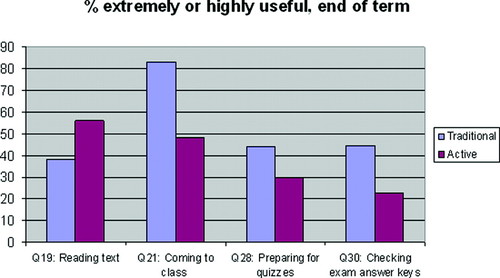
Figure 2. Student assessment of the usefulness of various course elements (showing only items that yielded statistically significant differences).
Q19: Doing the assigned reading in the text (active section found more useful) (p = 0.011) | |||||
Q21: Coming to class (traditional section found more useful) (p = 0.000) | |||||
Q28: Preparing for unannounced quizzes (traditional section found more useful) (p = 0.022) | |||||
Q30: Checking exam answer keys [for the current term's exams] in the tutorial room (traditional section found more useful) (p = 0.010) | |||||
Student Evaluation of Teaching (SET) Scores
Student evaluations of the instructors (on items such as overall teaching ability, knowledge of subject, respect and concern for students, how much learned, the course overall) were significantly and substantially higher in the traditional than in the active section (Table 4). The response rate for this online survey was ∼50% for both sections.
| Traditional (112 responses, 46.7%) | Active (127 responses, 48.3%) | |
|---|---|---|
| SET scores out of 7 | ||
| Overall teaching ability | 6.0 (SD = 0.9) | 5.0 (SD = 1.6) |
| Knowledge of subject | 6.4 (0.8) | 6.1 (1.2) |
| Respect and concern | 6.4 (0.8) | 5.6 (1.7) |
| How much learned | 4.9 (1.2) | 4.2 (1.5) |
| Course overall | 5.4 (1.3) | 4.4 (1.8) |
| Yes/No items | ||
| In-class learning activities contributed to my learning | 72% yes | 54% yes |
| I would take another course with this instructor | 84% yes | 54% yes |
| Written comments | Consistently excellent | Large amount of variation |
Attendance
Attendance in both sections was relatively high for a large, introductory course. We attribute good attendance to the use of frequent (n = 15) unannounced quizzes in both sections. However, overall attendance (measured as the average proportion of students taking the 15 unannounced quizzes) was significantly higher in the active section than in the traditional section (.968 vs. 0.927, p < 0.01). This may be partly or entirely due to time of day; the active section began at 11:15 a.m., as opposed to 8:15 a.m. for the traditional section.
Qualitative Data
Narrative data were gathered from an analysis of nearly 150 responses to open-ended questions on the end-of-term SET form and from a student focus group held in October 2006. Several prominent themes emerged from these data, including:
Professor focus in the traditional section; class focus in the active section. Positive written comments from students in the traditional section showed a strong tendency to praise the professors (their personal qualities, enthusiasm, etc.). Positive comments from students in the active section tended to praise the class itself (the activities in it, its content, etc.).
Concern to know the right answer. Focus group students expressed a strong desire to be told the correct answer about any question, issue, or problem that arises in class. This was one source of complaint about the active-learning exercises, namely that they did not always eventuate in being told what the truth is in clear, unambiguous terms. This complaint was bolstered by student perceptions that good performance on class exams required knowing correct, factual answers—rather than, for instance, general principles. Nonetheless, when asked directly students reported that they do not mind being held responsible for material not explicitly “covered” in class, as long as they know where to locate the needed information.
Moderately positive perceptions of group work. Focus group students had few complaints about the logistics and implementation of the group activities. There was some agreement that explaining things to others helps to reinforce knowledge; some agreement that in groups, different people understand different things and so can help each other; and broad agreement with the general thought that large class size is alienating, but that small groups help to combat these feelings.
Student views of learning. In both written responses and focus group discussion, students expressed the view that learning is the accumulation of unambiguous facts; that good teaching is the efficient delivery, from professor to student, of such facts; and that performance on exams is the sign of having learned in this sense.
Student desire for blending of formats. Data from both sources showed a strong student preference for a balanced mixture of active learning with presentation-mode class formats.
DISCUSSION
Our main conclusion is that active learning can work, even in large-class environments. The learning outcome data we collected indicate that our students learned at least as well, and in fact somewhat better, in a class that markedly reduced lecture in favor of active, student-centered activities. The students who seemed to benefit the most were those at the bottom end of the performance curve. This is particularly good news for at-risk populations in gateway courses.
A number of worries remain, however, about using active-learning techniques in large classes. For instance, students in the active-learning section finished the term with significantly lower confidence in some of their science-related skills and knowledge. The active-learning students also valued reading the textbook more, and going to class less, than their colleagues in the traditional section. We hypothesize that these results show the power of the student views about teaching and learning noted above. Because there was very little direct presentation of information in the active-learning section, students may have felt they were not learning. But our learning outcome data show that they did learn, confirming what others have noted (Gremmen and Potters, 1997; Emerson and Taylor, 2004), namely that student perceptions of their own learning are not always accurate. In fact, students may have been given a more authentic taste of scientific practice by being faced—repeatedly—with real-world phenomena, data, and ambiguity.
One common source of instructor resistance to active-learning techniques is the worry that these techniques take time away from lecture, which means that not all of one's course material can be covered in a more student-centered class. It is true that active learning takes time, but our data suggest that there is no need to present everything in class. Certain topics lend themselves to independent learning, and our qualitative data show that students are not disturbed by being held responsible for material that was not “covered” in class as long as they are made aware of what they must learn on their own.
Our implementation of active learning could be improved. Many students, particularly underclassmen, see learning as the accumulation of unambiguous information and resist active-learning techniques when they believe these techniques fail to provide them with needed information. Classroom activities could therefore be structured in such a way that they do not compete with students' needs. A concerted effort to explain to students that class time will be spent on activities designed to grapple with the most difficult concepts, classroom assessments, and customized mini-lectures may help create a better perception that classroom activities are meeting students' needs. The implementation described herein did not include a comprehensive explanation of active learning, nor were we overtly solicitous of student metacognition. Research shows that first-year students in particular are more receptive to active-learning techniques, so proper introduction of their value seems imperative to capture the enthusiasm of all students (Messineo et al., 2007).
One way to accomplish a more positive student reception of active-learning courses would be to organize classes so as to achieve a judicious balance of student-centered activities and presentation-style instruction. There were many indications in our qualitative data that students would welcome a class structure that split time approximately evenly between active-learning exercises and mini-lectures.
Further, students' desire to know the right answer could be accommodated by ensuring that active-learning exercises scaffold students to the point at which they grasp the relevant information, or by integrating such exercises with mini-lectures that present factual information more directly. Finally, instructors should be sure that class activities align properly with what is measured by class exams.
The substantial disparity in SET scores noted above represents a further worry about using active-learning techniques in large classrooms. To the extent that student evaluations figure into the faculty reward system, this disparity could function as a significant deterrent to faculty who might otherwise like to introduce greater variety into their lecture-based classes.
Our hypothesis is that SET scores in the traditional section were high because both professors are energetic, experienced, and likeable instructors. They are good performers who work well in the lecture-mode classroom. As noted above, lecturing directs student attention toward the lecturers themselves rather than toward other features of the class. By contrast, the active-learning section was the first time either instructor had taught a class in this mode. The majority of the activities were developed just before or during fall semester 2006, and student responses indicate that some of the activities were simply unsuccessful.
We believe, therefore, that SET scores for large classes that involve active learning will improve when instructors become more experienced and comfortable with this mode of teaching; when the learning activities themselves have been fine-tuned; and when the class features a balance of active learning with mini-lectures. Furthermore, insofar as it is possible and effective, instructors should make an effort to explain fully the value of active learning and to dispel the tendency to view it as simplistic or unrelated to assessments.
We were pleased to find a significant increase in class attendance in the active section, despite the fact that the number of unannounced quizzes was the same in both sections. We were also somewhat surprised by this finding, given that students in the active section valued coming to class significantly less than students in the traditional section did. It is possible that students feel less anonymous in a class devoted to active learning than in a lecture-based class, and that this feeling motivated greater attendance. This same perceived loss of anonymity might also contribute to students' preference for a traditional approach in required courses (Machemer and Crawford, 2007).
Attendance may also function as a mediator variable in the context of this study, because attendance was significantly correlated with student learning outcomes (r = 0.435, p < 0.01). In other words, as Freeman et al. (2007) note, attendance may be a mechanism by which active learning has some of its effects on student learning outcomes.3 However, because attendance is likely to be confounded with a number of other variables (e.g., high-performing students may be more likely to attend class), it is difficult to determine the degree to which this is true.
CONCLUSION
The passion over the questions of whether and how much to lecture is easy to understand, particularly when facing the problems of teaching a large class. When viewed from the back row, it's quickly apparent that a lot is going on while we're talking: students are watching movies, text-messaging their friends, reading the newspaper, filling in sudoku grids, eating, doing homework for other courses, and sleeping. The temptation is to say these are intractable and systemic problems born of the physical architecture and the business model that demands large courses.
But we are close to a tipping point at which we can recognize that “active learning” or “scientific teaching” or “engaged pedagogies” make a significant difference in large lecture formats (Handelsman et al, 2004; Prince, 2004; Smith et al., 2005). Our findings push us closer to this point, by showcasing the positive effects of active teaching methods on learning outcomes, particularly for low-performing students. Given constraints on the average instructor's time and student expectations for content delivery, however, we believe a mixed-format approach may be the best plan for large lecture classes. Far from advocating wholesale abandonment of lecture, we must recognize the evolution of classroom practices that include different ways of engaging students.
ACKNOWLEDGMENTS
The authors wish to thank The Archibald Bush Foundation for financial support of logistics, and the staff in the Biology Program at the University of Minnesota for institutional support. Additional thanks are due to Christina Yi and Allison Moriyama for classroom assistance. S. H. Cotner and M. D. Decker were the instructors of the courses described herein.
FOOTNOTES
1 See https://eval.umn.edu/showTemplates.pl?templateid=1067 for the SET form used in this class.
2 For more information, see www.sencer.net.
3 Freeman and colleagues also found that active learning has good effects on low-performing students. See Freeman et al., 2007.