Abstract
Note from the Editor
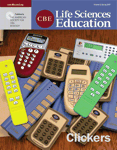
Use of the audience response devices known as “clickers” is growing, particularly in large science courses at the university level, as evidence for the pedagogical value of this technology continues to accumulate, and competition between manufacturers drives technical improvements, increasing user-friendliness and decreasing prices. For those who have not yet tried teaching with clickers and may have heard unsettling stories about technical problems with earlier models, the decision to use them and the choice of an appropriate brand may be difficult. Moreover, like any classroom technology, clickers will not automatically improve teaching or enhance student learning. Clickers can be detrimental if poorly used, but highly beneficial if good practices are followed, as documented in a growing body of educational literature.
In this Special Feature, we present two reviews that should assist instructors and teachers at all levels in taking the step toward clicker use and choosing an appropriate model. In the first, Barber and Njus compare the features, advantages, and disadvantages of the six leading brands of radio-frequency clicker systems. In the second, Caldwell reviews the pedagogical literature on clickers and summarizes some of the best practices for clicker use that have emerged from educational research. In a related article elsewhere in this issue, Prezsler et al. present the results of a study showing that clicker use can improve student learning and attitudes in both introductory and more advanced university biology courses.
Two years after the first low-cost radio-frequency audience response system using clickers was introduced for college classrooms, at least six different systems are on the market. Their features and user-friendliness are evolving rapidly, driven by competition and improving technology. The proliferation of different systems is putting pressure on universities to standardize or otherwise limit the number of different clickers a student is expected to acquire. To facilitate that choice, the strengths and weaknesses of six systems (eInstruction Classroom Performance System, Qwizdom, TurningPoint, Interwrite PRS, iClicker, and H-ITT) are compared, and the factors that should be considered in making a selection are discussed. In our opinion, the selection of a clicker system should be driven by the faculty, although students and the relevant teaching and technology support units of the university must also participate in the dialogue. Given the pace of development, it is also wise to reconsider the choice of a clicker system at regular intervals.