Teaching without a Textbook: Strategies to Focus Learning on Fundamental Concepts and Scientific Process
Abstract
Note from the Editor
Textbooks are ubiquitous. They are available for almost every conceivable subdiscipline of biology, and few of us would consider teaching a course without using a textbook. Over the years, they have become more colorful, more encyclopedic, and accompanied by more ancillary materials such as CD-ROMs, study guides, and websites. With all these tools to assist our students, it seems reasonable that they are able to learn more and better than ever. Thus, the question most instructors ask themselves is most likely which textbook to use, not whether to use a textbook. But does the use of textbooks really help students learn better? In this Point of View, I invited a commentary on this question from a faculty member who has decided to abandon the use of a textbook in an introductory level cell and molecular biology course.
—Gary Reiness
“The faster science and technology advance—the more important it is to teach and to learn the basics of math and science and the less important it is to teach and to learn the latest developments.”
–Harari's Law of Science Education
“There seemed to be a mystifying universal conspiracy among textbook authors to make certain the material they dealt with never strayed too near the realm of the mildly interesting …”
–A Short History of Nearly Everything, Bill Bryson
SUMMARY
Are textbooks useful, or are they an unnecessary expense or even an obstacle to robust conceptual understanding? Clearly, the answer depends upon course context—what are the goals of the course, how could the textbook be used to achieve these goals, does this use justify the cost of the textbook, and are there more educationally effective or cost-effective alternatives available? I discuss these questions from the perspective of a course I teach: Molecular, Cellular, and Developmental Biology (MCDB) 1111: Biofundamentals, an introductory lecture and virtual laboratory course that uses online materials rather than a textbook.
INTRODUCTION
There is little research on the impact of textbooks on student learning. Carpenter et al. (2006) provide a description of publisher-funded studies on textbook use in Britain. They outline two key points worth recognizing. First, textbook publishers and authors seem to have little appreciation of how students learn. Second, students are often motivated more by the desire to attain a degree rather an inherent love of, or interest in, course subject matter. At the same time, both students and instructors value textbooks, even though “there is no correlation between textbook purchase and the grade achieved” (Carpenter et al., 2006). Similar results have been reported in U.S. chemistry and physics courses (Cummings et al., 2002; Smith and Jacobs, 2003; Podolefsky and Finkelstein, 2006). Given that students view textbooks as references rather than learning tools, it is curious why instructors do not assign books that are designed to be reference works, such as the Penguin (Thain and Hickman, 2004) or Oxford (Martin et al., 1996) dictionaries of biology, both of which cost less than $US20, compared with popular textbooks that can cost $120 or more.
Although publishers and textbook authors may argue that the rapid pace of discovery in biology necessitates constant revisions, and so high costs, there is also the obvious business logic that new editions act to suppress the used book market (see Committee on Undergraduate Science Education, 1997, and Fairchild, 2004, for a more dispassionate view). The argument for new textbook editions is based on two assumptions: that students need to learn the latest discoveries to have valid conceptual understanding of biological systems and that textbooks are the best way to provide such information. Both assumptions fly in the face of research into student learning: It is common to find that students lack an accurate and confident understanding of basic biological concepts, such as the random nature of diffusion; the continuous nature of molecular interactions; the distinction between the genetic code and genetic information; the concepts of homology, analogy, and convergence; and molecular bases of fundamental processes such as allostery, transcription, translation, RNA and polypeptide turnover, and gene expression (Klymkowsky, 2007; Garvin-Doxas and Klymkowsky, unpublished observations). For various reasons, there is a tendency to neglect rigorous presentation of basic ideas and processes and to concentrate on often trivial details. Introductory courses often focus on detailed catalogs of the molecular components of transcription and translation initiation complexes and replication forks, whereas students remain confused about basics of DNA, RNA, and protein structure and function.
TEACHING WITH AND WITHOUT A TEXTBOOK
Since 1983, I have taught courses ranging in size from Introduction to Molecular Biology (∼400 students), which used a textbook, to smaller (20- to 40-student) “critical-thinking” courses, some of which used no textbook. All the larger required lower-level undergraduate courses taught by other faculty in the department also use textbooks. Over the same period, through discussion with undergraduate students working in my lab, I amassed a substantial body of anecdotal evidence suggesting that students could pass through the MCDB curriculum without attaining a “working” understanding of the materials presented. In an attempt to help remedy this situation, I developed and taught an introductory course in molecular and cellular biology, MCDB 1111: Biofundamentals (http://www.colorado.edu/MCDB/MCDB1111), without a textbook. I conceived Biofundamentals as a “transformed” introductory course (more about that below), and because I was generally dissatisfied with available textbooks, I decided to develop my own Web-based materials. While an editor of The Dynamic Cell (Dawson et al, 2000), I began to think about teaching technologies, and I started work with Tom Lundy and Spencer Browne to develop Flash-based virtual laboratories (http://virtuallaboratory.net, http://bioliteracy.net).
EVOLVING BIOFUNDAMENTALS
After deciding that Biofundamentals would be Web-based, I set out to design and compose the course website (http://virtuallaboratory.net/Biofundamentals/), which includes both lecture and laboratory materials. After a probationary period, the course was accepted as an alternative to the traditional majors' lecture and lab courses. Over the 5 years that I have taught the course, it has evolved through the incorporation of learning assistants (LAs; see below), student response systems, tutorials, and redesigned exams, but it remains true to original design, namely, to engage students so that they can identify and work with basic biological concepts to analyze biological systems. Course learning goals are presented at http://www.colorado.edu/MCDB/MCDB1111/goals.html.
The use of LAs came about through my participation in the science, technology, engineering, and math (STEM)-teacher preparation program at the University of Colorado, Boulder. The goal of this program is to encourage STEM majors to pursue careers in K–12 teaching (Otero et al., 2006). LAs are talented undergraduates who are given stipends, trained through a course in pedagogy offered by the College of Education (http://cosmos.colorado.edu/stem), and directly involved in undergraduate instruction.
At the same time, my colleague Kathy Garvin-Doxas and I have been working together on a National Science Foundation-funded project to build a Biology Concept Inventory (BCI). We have used a Web-based database system we developed called Ed's Tools (Garvin-Doxas et al., 2007).
The most important practical insight to emerge from the BCI project is that instructors, myself included, are often oblivious about student thinking on particular issues and ideas. Such an understanding requires listening to students talk freely about their assumptions when answering questions or solving problems. For example, students are often deeply confused about the role of random events in biological systems, and this confusion ranges from molecular motions as the basis of diffusion to the origin and nature of mutations and evolutionary processes, such as genetic drift. Such underlying and unrecognized confusion leads to what we term “destructive conceptual interference” that makes a nuanced understanding of biological processes extremely difficult to attain (Klymkowsky, 2007; Garvin-Doxas and Klymkowsky, unpublished data). In response to an in-class “clicker” question, and confirmed through analysis of ∼80 responses to the Ed's Tools question “What is the meant by genetic code?”, it is clear that there was general confusion as to the distinction between the genetic code as an algorithm for reading information and as genetic information. This confusion seems to underlie students' difficulty in understanding the homologous nature of the genetic code. It also serves as a warning that ideas instructors take as obvious are often problematic for students.
HOW DOES BIOFUNDAMENTALS WORK?
Biofundamentals typically has an enrollment of 50–80 students. In addition to standard class times, students are required to attend a session run by an LA, during which they tackle tutorial problems and general concept maps of materials presented. From the course home page, students can jump to content materials (Figure 1) that can be read online or downloaded as PDF files, and to tutorial questions, which are answered before class through the CULearn Web-based support system. Some students feel a strong need for a textbook; I recommend that they purchase either one of the “dictionaries of biology” (Martin et al., 1996; Thain and Hickman, 2004) or access textbooks and reference materials available online, e.g., the National Center for Biotechnology Information Bookshelf (http://www.ncbi.nlm.nih.gov/sites/entrez?db=Books&itool=toolbar) or Wikipedia. Embedded within the course readings are questions for students to consider; in class, these questions (reviewed through the use of clickers) are the focus of small-group and whole-class discussions aimed at encouraging students to articulate their assumptions.
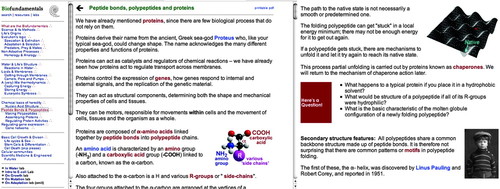
Figure 1. Course readings are presented along with the virtual labs at the Biofundamentals website. Within these readings, embedded “Here's a question” questions serve as the jumping-off point for in class discussion.
TUTORIALS
In physics, there are a number of rigorously developed student “tutorials” that go beyond simple problems (McDermott and Scaffer, 2003; Redish, 2003). According to one publisher, “The emphasis in the tutorials is not on solving the standard quantitative problems found in traditional textbooks, but on the development of important physical concepts and scientific reasoning skills.” Similar researched tutorial exercises are not, to my knowledge, currently available for molecular biology, and so we have begun to develop our own (see Figure 2). However, these tutorials are only the first step in a more rigorous process that includes analysis of how students respond to them and what students gain once they have completed them. That said, the tutorials seemed to be a useful way of 1) pressing students to build on materials discussed in class period; 2) presenting materials in an alternative context; 3) collecting student responses through the CULearn website; and 4) introducing students to the type of questions that they will see on exams. Students are encouraged to work together on tutorials.
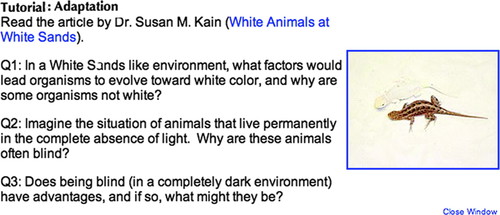
Figure 2. A tutorial (in need of further study, revision, and testing) from Biofundamentals; students submit their answers through the CULearn website.
EXAMS AND PEDAGOGICAL CREDIBILITY
A key, and often underemphasized, aspect of any “nontraditional” or nonconventional course involves convincing students that the approaches upon which the course is based will be valuable to them, i.e., that the exercises and other requirements of the course will help them score well on the exams (and increase their understanding). Therefore, it is important to consider in detail the nature of exams and the messages they send to students. If exams require only recall, or the questions can be answered without understanding underlying ideas, complex pedagogical interventions are unnecessary and will be perceived (rightly) by students as a waste of time. This same point applies to textbooks; if student grades bear no correlation to whether they do or do not read the textbook, the textbook can be disregarded as a costly irrelevancy or an unnecessary “security blanket.”
We have described the use of implicit, confidence-type, multiple-choice tests (Klymkowsky et al., 2006). In such exams, students pay a penalty for being confidently wrong, and they get the most points for being confidently correct. More recently, we have modified this exam format to allow students to qualify their responses by making their assumptions explicit (Figure 3). We find that this has a number of benefits; these exams include features of essay questions, but they are faster to grade, and they provide a more complete picture of student thinking than simple multiple-choice exams. In addition, questions can be made more ambiguous (i.e., realistic), and so avoid “telegraphing” the correct answer, something that occurs when one is trying to make the correct answer unambiguous. This type of exam encourages students to look beyond “right or wrong” and to approach questions in a manner similar to the approach used by scientists, i.e., can a specific question be answered unambiguously? If so, what information do I need to know or assume to arrive at an answer? How might my answer be confirmed?
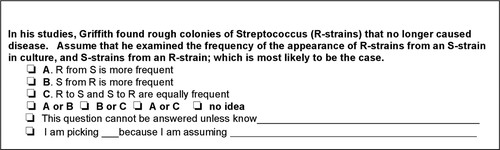
Figure 3. Example of a concept-centric multiple-choice question used in Biofundamentals.
An important aspect of course design is that students are given an opportunity to revisit topics and to improve their original exam scores by subsequently taking “I know it now” exams. These exams are similar to midterm versions, except that there are no alternative (i.e., “A or B”) or “no idea” options on multiple-choice exams. I know it now exams reinforce the message that learning the subject matter is the goal of the course.
WHEN AND WHERE TO USE A TEXTBOOK
Clearly, the issue of whether to use a textbook is complex, and it is dependent upon course and curricular goals. Students (and colleagues) expect a textbook; yet often, the textbook is not used, except as a reference. Most textbooks are not written with current evidence about best teaching and learning practices in mind, so they may be difficult to integrate into the design and presentation of a course that is based on this evidence. Because many instructors provide detailed online or downloadable notes, it would be a worthwhile exercise to consider whether a textbook is required, or whether other materials could serve its purpose. In the end, the result may be a more thoughtful approach to what is taught, how it is taught, and how student mastery is assessed.
ACKNOWLEDGMENTS
I thank Kathy Garvin-Doxas and Isidoros Doxas for discussion and insight, and Diana Darnell for comments on the text. I thank the discipline-based education research group at University of Colorado, Boulder, for providing a stimulating environment, and the learning and research assistants (Sierra Hill, Rebecca Green, Laurie Wacker, Savannah Hill, John Wood, and Rachel Gheen, Linda Taylor, and Shana Spindler) who provided critical “student-centric” feedback. Research and development of the Biology Concept Inventory was funded by a grant from the National Science Foundation.